

Home›The Treatise›Chapters›Chapter 105
Tratado de Cirurgia da Coluna Vertebral
SECTION 10 • Complementary Topics
Chapter105

Intraoperative Bleeding Control

Vancouver: Paula EV, Cralcev C, Isaias GAB📖 Pages: 1273-1282
Full reading of this chapter is available exclusively in the printed edition of the Treatise.
Sec. 10Complementary Topics
Cap. 105Clinical Chapter
3authors
Português
Español
English
Referênciasscientific citations
📑

Chapter Summary

• Context: Spine surgery, particularly in complex deformities, multi-level reconstructions, oncologic resections, and revision procedures, can involve substantial intraoperative blood loss. Hemorrhage obscures surgical visibility, increases operating time, and causes hypovolemia, hypothermia, acidemia, and dilutional or consumption coagulopathy. Massive bleeding and allogeneic blood transfusions are independently associated with increased surgical site infections, pulmonary complications, extended ICU stays, and transfusion-related immunomodulation (TRIM). Intraoperative bleeding control cannot be approached as a reactive response to hemorrhage; it requires an integrated, proactive Patient Blood Management (PBM) framework spanning preoperative optimization, surgical positioning, precise intraoperative hemostasis, pharmacological antifibrinolytics, viscoelastic coagulation testing, and restrictive transfusion protocols.
• Chapter Objective: To present comprehensive strategies for intraoperative bleeding control and patient blood management in spine surgery. The reader will learn to evaluate preoperative bleeding risk, optimize prone positioning to reduce venous congestion, apply topical and systemic hemostatics (tranexamic acid), utilize viscoelastic coagulation testing (TEG/ROTEM), and implement rational, context-driven transfusion protocols.
• Preoperative Risk Assessment and OptimizationIdentifying preoperative anemia, nutritional deficiencies, and coagulopathies is essential. Anticoagulants and antiplatelet agents must be managed according to standardized suspension intervals. Preoperative iron supplementation and erythropoietin are indicated for elective patients with iron-deficiency anemia.
• Surgical Positioning and Venous DecompressionProper prone positioning on chest and pelvic bolsters ensures the abdomen hangs completely free without pressure. This prevents inferior vena cava compression, decompressing Batson's valveless epidural venous plexus and significantly reducing diffuse venous bleeding throughout the exposure.
• Pharmacological and Topical HemostasisIntravenous tranexamic acid (TXA) reduces blood loss and transfusion requirements in adult and pediatric deformity surgery with proven safety. Topical hemostatics (gelatin sponges, microfibrillar collagen, oxidized cellulose, thrombin, and fibrin sealants) provide adjunct hemostasis on decorticated bone beds and epidural spaces.
• Coagulation Monitoring and Viscoelastic TestingPoint-of-care viscoelastic testing (Thromboelastography - TEG / Rotational Thromboelastometry - ROTEM) rapidly evaluates clot formation kinetics, firmness, and fibrinolysis in real time. Viscoelastic guidance allows targeted administration of specific blood products (fibrinogen concentrate, cryoprecipitate, platelets) rather than empirical transfusion.
• Patient Blood Management (PBM) and TransfusionPBM rests on three pillars: optimizing erythropoiesis, minimizing intraoperative blood loss (cell salvage, meticulous bipolar/hemostatic technique), and applying restrictive transfusion triggers (Hb < 7.0-8.0 g/dL based on hemodynamics and tissue perfusion). Red blood cell salvage and autologous reinfusion are highly effective in major fusion surgery.
• Clinical Application: In major deformity or tumor surgeries, bleeding management begins weeks prior with anemia treatment and anticoagulant management. In the operating room, ensure proper prone positioning with zero abdominal pressure. Initiate weight-based intravenous tranexamic acid prior to incision. Deploy intraoperative cell salvage. In the presence of significant diffuse bleeding, use ROTEM/TEG to determine whether hypofibrinogenemia, thrombocytopenia, or hyperfibrinolysis is responsible. Avoid empirical plasma transfusions, targeting specific factor deficiencies, and maintain normothermia and physiological pH to support native coagulation enzymes.
🏷️

Keywords

Preferred DeCS/MeSH Descriptors:
Blood Loss, SurgicalHemostasis, SurgicalBlood TransfusionTranexamic AcidThrombelastographySpinal Fusion
⭐

Why this chapter matters

Massive hemorrhage and allogeneic blood transfusion drastically increase postoperative morbidity, infections, and hospital costs in spine surgery. A systematic Patient Blood Management strategy mitigates bleeding risk, preserves patient physiology, and prevents transfusion-related complications.

“Intraoperative bleeding control in spine surgery is a continuous multidisciplinary process rooted in Patient Blood Management. Success depends on preoperative optimization, prone venous decompression, systemic tranexamic acid, viscoelastic-guided targeted hemostasis, and restrictive transfusion practices.”
✨

Chapter Highlights

🌐
Card 1 — Essential Concept
PBM is a Proactive Strategy

Patient Blood Management begins before skin incision by correcting preoperative anemia, timing anticoagulant withdrawal, and decompressing the abdomen in the prone position to minimize venous bleeding.

🩺
Card 2 — Clinical Decision
Viscoelastic-Guided Targeted Hemotherapy

Using TEG or ROTEM during major hemorrhage identifies whether hypofibrinogenemia, platelet deficit, or hyperfibrinolysis is present, allowing targeted factor replacement instead of blind empirical transfusion.

📐
Card 3 — Pearl or Alert
Tranexamic Acid is an Evidence-Based Standard

Intravenous tranexamic acid significantly reduces intraoperative blood loss and allogeneic transfusion rates in complex deformity and multi-level spinal fusion without increasing thrombotic risk.

📑

How to Cite this Chapter (Vancouver Format)

Official bibliographic indexing and citation guidelines
📖 Pages: 1273-1282Vancouver Style
Authors (Vancouver):Paula EV, Cralcev C, Isaias GAB

Paula EV, Cralcev C, Isaias GAB. Controle do sangramento intraoperatório. In: Pudles E, Defino H, Risso M, editors. Tratado de Cirurgia da Coluna Vertebral (Treatise of Spine Surgery). 1st ed. Rio de Janeiro: Dilivros Editora; 2026. p. 1273-1282.

ISBN: 978-85-8053-292-0 • 1.ª Edição • Dilivros Editora
📚

Bibliographic References

1. Elgafy H, Bransford RJ, McGuire RA, et al. Blood loss in major spine surgery: are there effective measures to decrease massive hemorrhage? Spine. 2010;35(Suppl 9S):S47-56.
2. Yoshihara H, Yoneoka D. Predictors of allogeneic blood transfusion in spinal fusion for pediatric patients with idiopathic scoliosis. Spine. 2014;39(22):1860-7.
3. Mikhail C, Pennington Z, Arnold PM, et al. Minimizing blood loss in spine surgery. Global Spine J. 2020;10(1 Suppl):71S-83S.
4. Naik BI, Pajewski TN, Bogdonoff DL, et al. Rotational thromboelastometry-guided blood product management in major spine surgery. J Neurosurg Spine. 2015;23(2):239-49.
5. Yang B, Li H, Wang D, et al. Systematic review and meta-analysis of perioperative intravenous tranexamic acid use in spinal surgery. PLoS One. 2013;8(2):e55436.
6. Le Huec JC, AlEissa S, Bowey AJ, et al. Hemostats in spine surgery: literature review and expert panel recommendations. Neurospine. 2022;19(1):1-12.
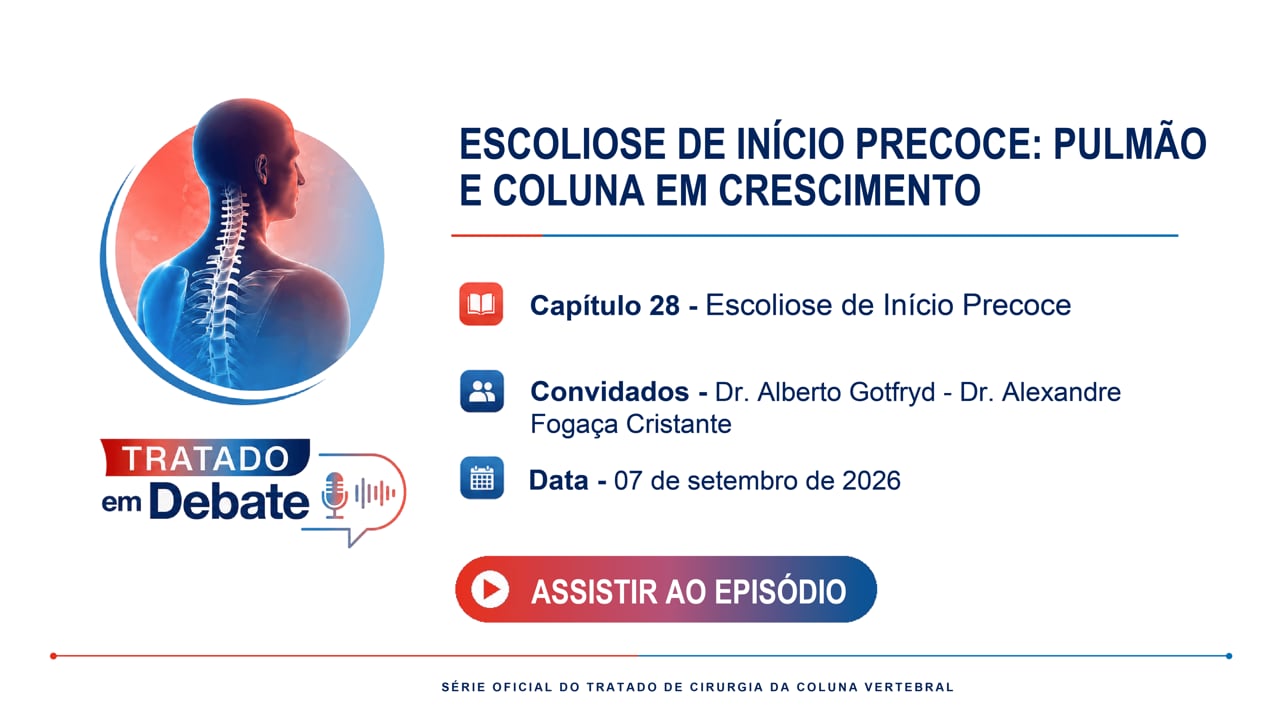
Episode 06 – Early-Onset Scoliosis
Scheduled Premiere
Exclusive Premiere • Wednesday, October 07 at 9:00 PM (BRT)
Wednesday, October 07 at 9:00 PM (BRT)
The live countdown will be activated on the eve of the premiere.

The full videocast will premiere automatically in this player on Wednesday, 10/07 at 6:00 PM (BRT).

Also premiering on Spotify
Treatise in Debate

Official videocast derived from the treatise chapters.

Episode 06 – Early-Onset Scoliosis

Lungs and the Growing Spine: thoracic development, C-EOS classification, and growth-friendly surgical techniques